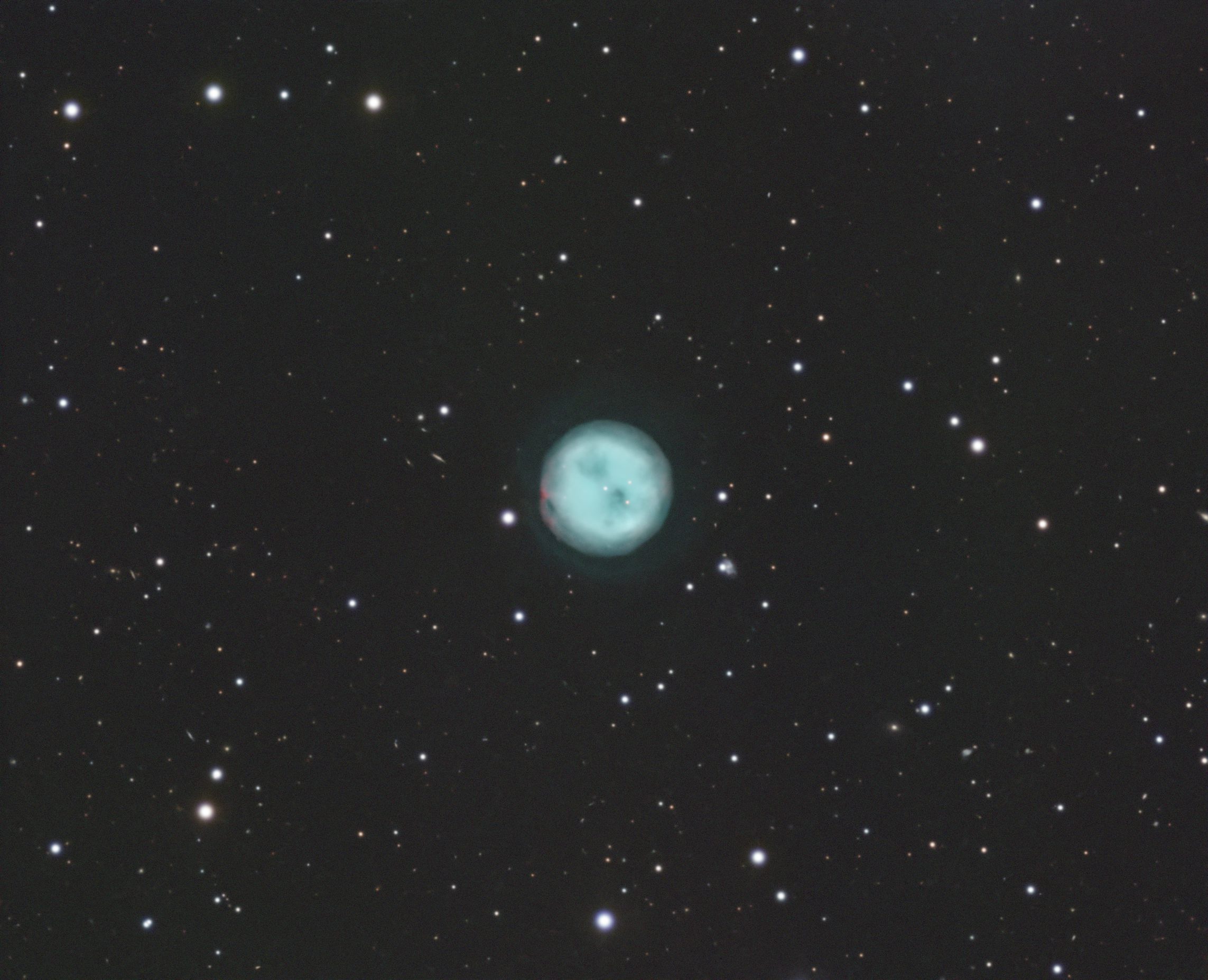
Owl Nebula (M97)
-
Object
Owl Nebula (M97)
-
Description
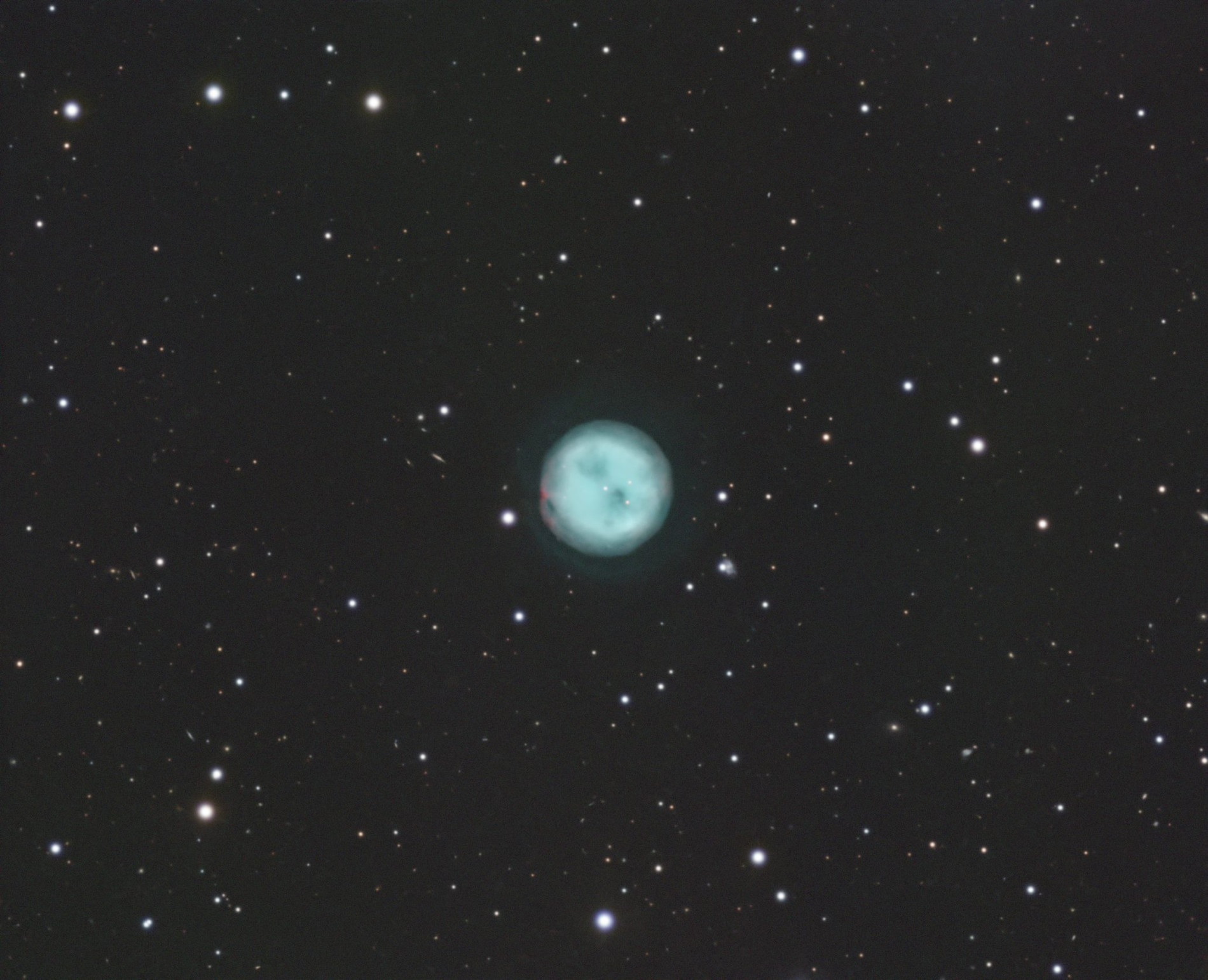
Messier 97, commonly known as the Owl Nebula, is a planetary nebula located roughly 2,000 light-years away in the constellation Ursa Major. It was formed when a Sun-like star reached the final stages of its evolution and expelled its outer layers into space. The nebula’s characteristic blue-green color comes primarily from doubly ionized oxygen, which dominates the emission from the expanding shell. Near the center, darker cavities create the familiar “owl” appearance, marking regions of lower density where material has been pushed aside by complex internal dynamics.
Beyond the brighter inner structure lies a very faint, diffuse halo that is only visible with deep imaging. This outer glow represents earlier episodes of mass loss, tracing the star’s transition from a red giant into a planetary nebula over tens of thousands of years. As the shell continues to expand and fade, it gradually enriches the surrounding interstellar medium with heavier elements, contributing to the cycle of stellar evolution that will eventually give rise to new stars and planetary systems.
Objects in image: M 97, NGC 3587, Owl Nebula -
Image
-
Scope
Explore Scientific 127ed APO refractor
-
Camera
ASI-1600mm pro (monochrome)
-
Mount
Paramount MYT
-
Filters
RGB filters
-
Guiding
Askar 400 with off axis guider
-
Exposure Info
14.5 total exposure time
Red: 77 * 4 minute exposures
Green: 71 * 4 minute exposures
Blue: 70 * 4 minute exposuresI also had 112 4 minute luminance exposures, but when I added that data in, it washed out the faint blue glow around the nebula, so I left it off.
-
Date
12/22/2025
-
Copyright
Photo copyright Thomas Kerns, Beluga Lake Observatory