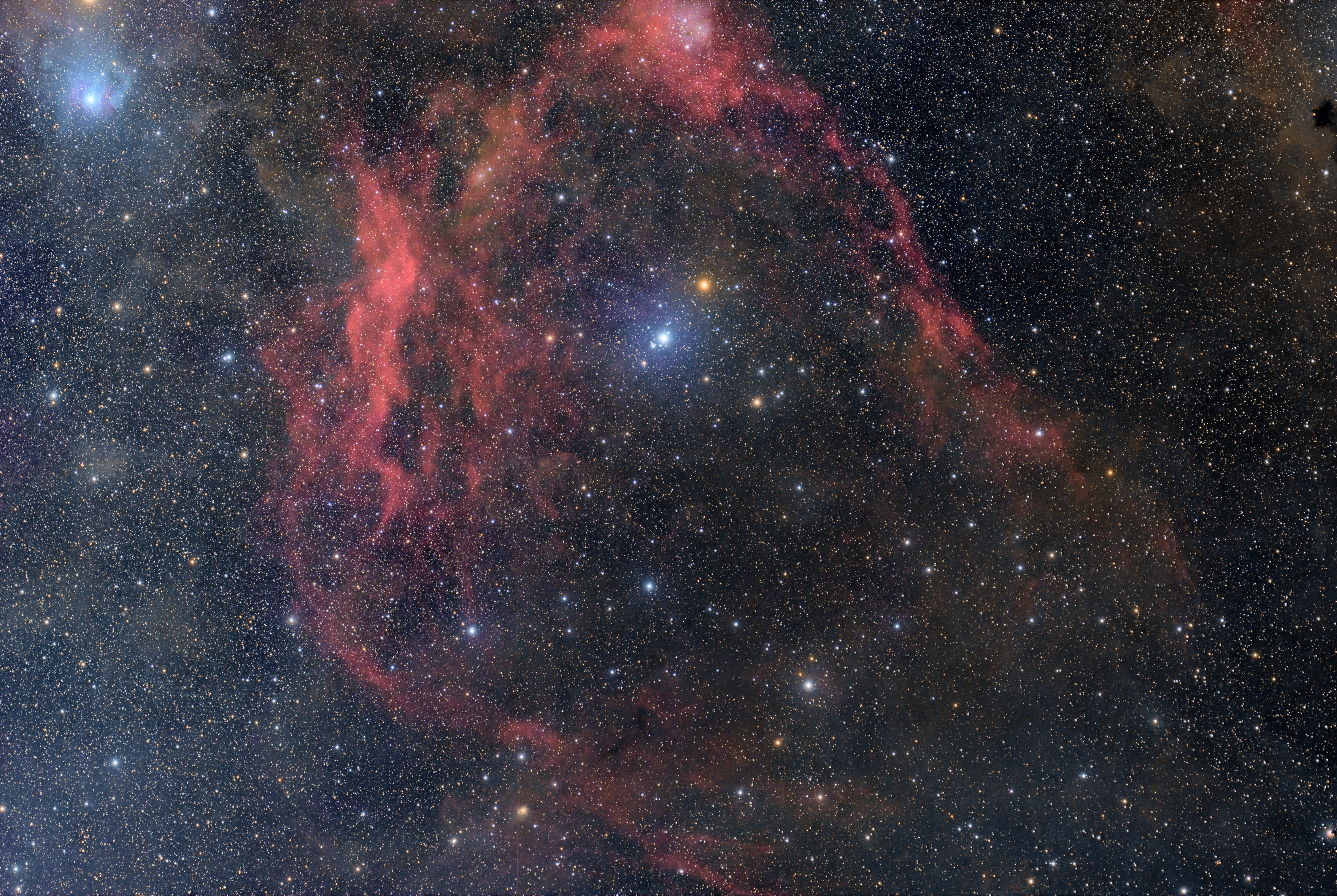
Flying Bat Nebula
-
Object
Flying Bat Nebula
-
Description
Sh2-129 – The Flying Bat Nebula (Sharpless 2-129) is a vast emission nebula and H II region located in the constellation Cepheus, approximately 2,300 light-years from Earth within the Cepheus molecular cloud complex and Cepheus OB2 stellar association. This 140-arcminute wide structure, discovered by Stewart Sharpless in the 1950s, glows primarily from hydrogen-alpha emissions energized by ultraviolet radiation from embedded hot, young stars, creating its distinctive bat-like wings spanning over 50 light-years across the sky. Nestled within Sh2-129 lies the rare bipolar outflow nebula Ou4 (the Squid Nebula), discovered in 2011 by French astrophotographer Nicolas Outters—a faint, teal [O III] structure possibly driven 90,000 years ago by the massive triple star system HD 202214/HR 8119 at its heart, which may represent either a planetary nebula precursor or dramatic stellar outburst. This widefield view (3.5° FOV) reveals the intricate interplay of glowing Ha filaments, faint reflection nebula vdB 140 nearby, and pervasive galactic cirrus dust lanes.
-
Image
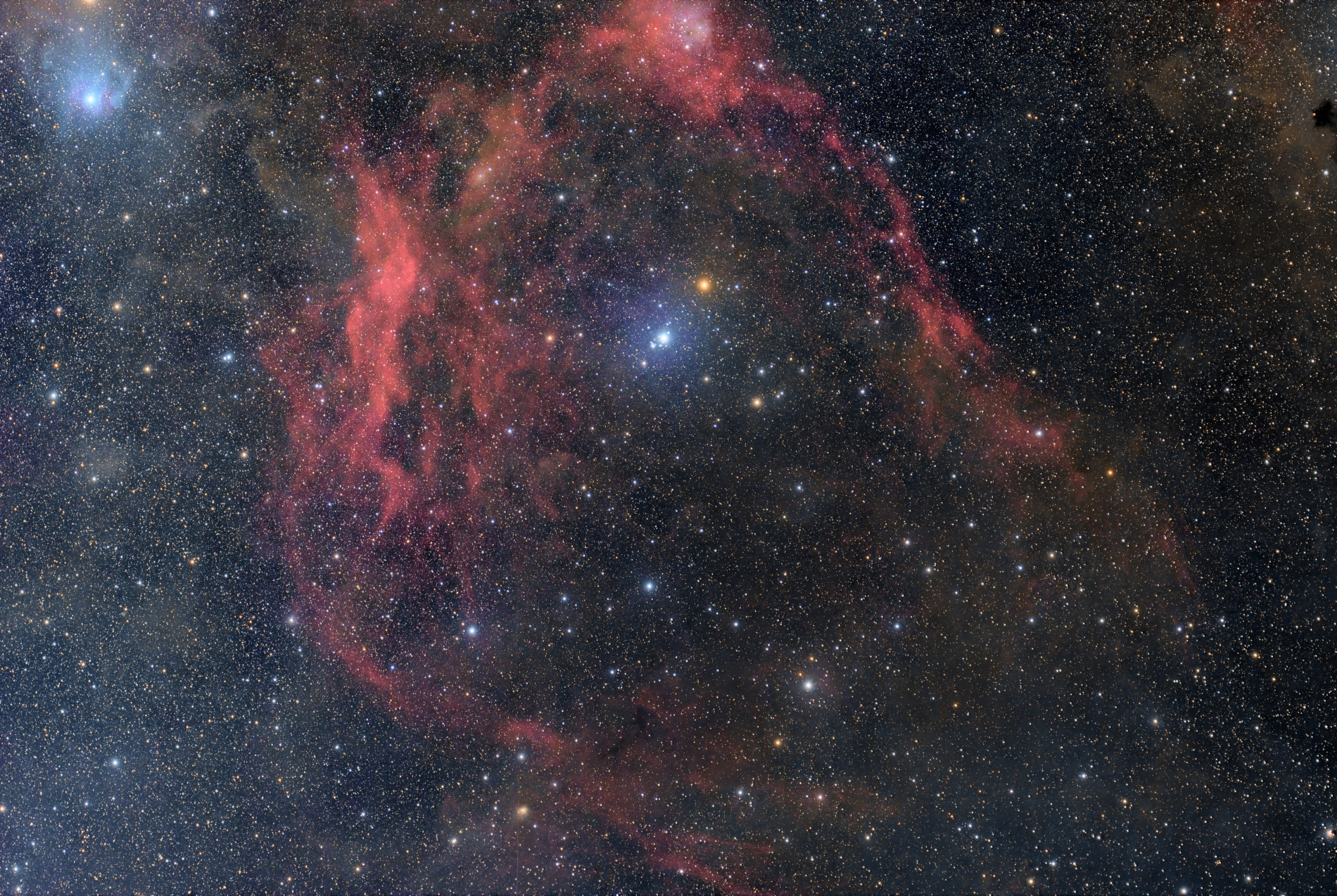
-
Scope
Askar FR400
-
Camera
ASI2600 mc
-
Mount
Paramount MYT
-
Filters
-
Guiding
Off Axis Guider
-
Exposure Info
260 4 minute exposures totaling over 17 hours exposure time
-
Date
12/28/2024
-
Copyright
Photo copyright Thomas Kerns, Beluga Lake Observatory